
Thinking about making Spain your home with a Non-Lucrative Visa? Understanding what happens after your first year is just as important as preparing your initial application.
Spain’s Non-Lucrative Visa is an attractive residency option for people who want to enjoy life in Spain without working. It is particularly relevant for retirees and individuals who have sufficient financial resources to support themselves independently.
However, moving to Spain involves more than securing your first visa. Understanding your residency conditions, renewal requirements and longer-term options can make a significant difference to how you plan your future.
One of the most important things to understand is that a Non-Lucrative Visa does not give you permission to work in Spain.
So, what happens when your first year comes to an end? How often do you need to renew your residency? And what changes after five years?
In this guide, the Into Spain Residency & Relocation Team explains what you need to know.
Watch: Understanding Spain’s Non-Lucrative Visa
In this video, Kelly, our Residency & Relocation Specialist at Into Spain, walks you through the typical Non-Lucrative Visa timeline, explains the restrictions on working and discusses what may happen after five years of legal residence.
Whether you are exploring your options or already living in Spain, understanding the process from the beginning can help you plan with greater confidence.
What Is the Non-Lucrative Visa in Spain?
The Spanish Non-Lucrative Visa is intended for eligible non-EU nationals who wish to reside in Spain without undertaking employment or professional activities.
Unlike residence routes designed for people who intend to work, the Non-Lucrative Visa requires applicants to demonstrate that they can support themselves financially without relying on employment.
This makes it a potential option for people who are financially independent, including retirees or individuals with sufficient savings or qualifying sources of passive income.
Applicants must meet a number of conditions, including financial requirements, suitable health insurance and other documentation requirements.
Initial applications are generally made through the Spanish consular office responsible for the applicant’s place of legal residence.
For many people, the appeal is the opportunity to build a new chapter in Spain while enjoying a different pace of life, the Mediterranean lifestyle and the freedom to settle into their new surroundings.
However, it is essential to understand the conditions attached to this type of residency before applying.
Can You Work in Spain on a Non-Lucrative Visa?
No. The Non-Lucrative Visa does not authorise employment or professional activities while you hold this type of residence.
This restriction is fundamental to the purpose of the visa.
It is not designed for individuals who intend to take up employment in Spain, undertake freelance work or actively operate a business.
What About Working Remotely for a UK Company?
This is a particularly common question among British nationals considering a move to Spain.
Working remotely for an overseas employer does not automatically make that activity compatible with a Non-Lucrative Visa.
If you intend to continue working remotely while living in Spain, you should consider an immigration route that specifically permits your intended professional activities.
For eligible applicants, Spain’s international teleworking residence route, commonly known as the Digital Nomad Visa, may be worth exploring.
Your individual circumstances, including the nature of your work and your longer-term plans, should be considered before choosing a residence option.
Does the Work Restriction Always Last Five Years?
Not necessarily.
The restriction applies while you hold Non-Lucrative Residence.
In some circumstances, it may be possible to apply to modify an existing residence authorisation to another category that permits work, provided the relevant requirements are met.
However, this should not be assumed to be automatic or guaranteed.
If you expect your circumstances to change, understanding your options from the outset is particularly important.
How Does the Non-Lucrative Visa Renewal Process Work?
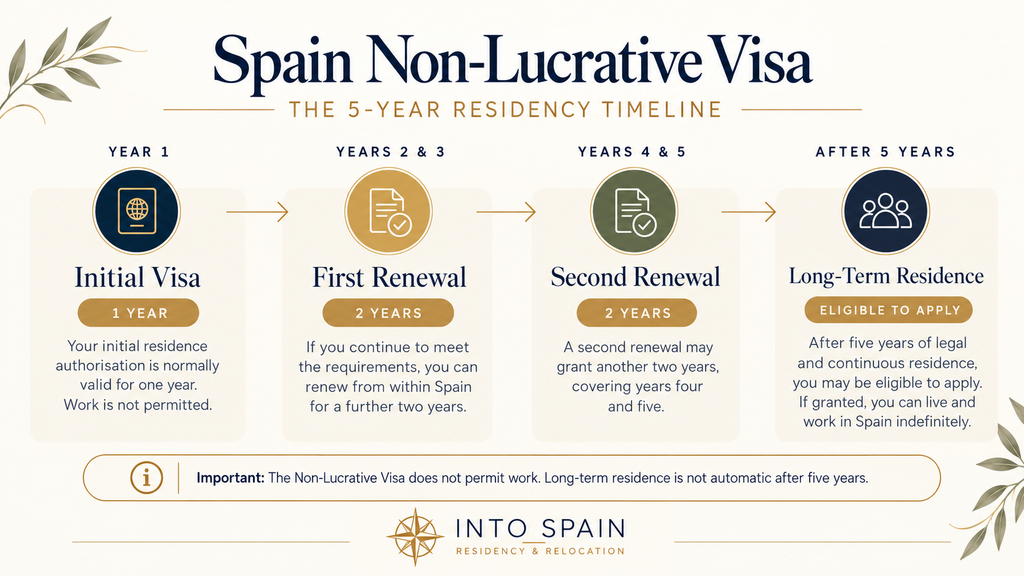
A standard Non-Lucrative Residence journey typically follows a structure covering an initial one-year period and subsequent two-year renewals.
Year 1: Your Initial Non-Lucrative Residence
Once your initial application has been approved and you enter Spain, your residence authorisation is normally valid for one year.
During this period, you must continue to comply with the conditions of your residence.
You will also need to complete the relevant formalities following your arrival, including applying for your TIE, the physical residence card, within the applicable timeframe.
Before your first year comes to an end, it is important to review your circumstances and prepare for renewal.
Years 2 and 3: Your First Renewal
If you continue to meet the applicable requirements, you may apply to renew your Non-Lucrative Residence from within Spain.
An approved renewal is normally valid for a further two years.
The renewal involves demonstrating that you continue to satisfy the relevant conditions, including sufficient financial resources and qualifying health insurance.
Your residence history in Spain also matters.
Renewal is not automatic, so preparing your documentation and understanding the application timeframe is essential.
Years 4 and 5: Your Second Renewal
Following the first two-year renewal, you may apply for another renewal if you continue to meet the requirements.
An approved second renewal normally provides a further two years of residency.
Throughout this period, the conditions of Non-Lucrative Residence continue to apply, including the restriction on carrying out employment or professional activities.
This brings the typical residency timeline to five years.
After Five Years: Long-Term Residence in Spain
After five years of legal and continuous residence in Spain, you may become eligible to apply for Spanish long-term residence.
This is an important distinction.
Completing five years of residency does not automatically grant long-term residence. You must satisfy the applicable requirements and submit an application.
If granted, Spanish national long-term residence allows you to reside and work in Spain indefinitely under the same conditions as Spanish nationals.
This provides a different legal position from temporary Non-Lucrative Residence.
It is also important to understand that periods spent outside Spain may affect your eligibility for long-term residence.
Planning ahead and keeping track of your residence history can therefore be particularly valuable.
What Are the Requirements for Renewing a Non-Lucrative Visa?
Although every application depends on individual circumstances, there are several important requirements to consider when preparing for a renewal.
Financial Resources
Applicants must continue to demonstrate sufficient financial means to support themselves, and any accompanying family members, for the period covered by their renewal.
The financial threshold is linked to Spain’s IPREM indicator, and the documentation required will depend on the applicant’s circumstances.
Health Insurance
Applicants must maintain qualifying health insurance that meets the applicable Spanish residence requirements.
It is important to review your policy and supporting documentation before submitting a renewal application.
Time Spent Living in Spain
Under the current Non-Lucrative Residence renewal rules, applicants must have resided effectively in Spain for more than 183 days during the calendar year.
This is a particularly important consideration for people who regularly travel between Spain and the United Kingdom or spend extended periods elsewhere.
The rules governing renewal and those governing continuity for long-term residence are not identical, so both should be considered when planning your time abroad.
Renewal Deadlines
Renewal applications can generally be submitted during the two months before the residence authorisation expires.
Applications may also be submitted within three months after expiry, although late submission can have legal consequences.
Preparing in advance gives you more time to review your documentation and address any potential issues.
For the current official requirements, consult the Spanish Ministry’s guidance on renewing Non-Lucrative Residence.
Is the Non-Lucrative Visa Right for Your Long-Term Plans?
The Non-Lucrative Visa can be a suitable option for individuals who have the financial means to live in Spain without working.
However, it may not be the most appropriate route for everyone.
Before applying, it is worth considering whether you intend to work in the future, how much time you plan to spend in Spain and whether your financial circumstances are likely to change.
For some applicants, the Non-Lucrative Visa fits naturally with their retirement or relocation plans.
For others, a different residence route may provide greater flexibility.
The right decision begins with understanding your individual circumstances and what you want your future in Spain to look like.
At Into Spain, we help clients explore their residency options and understand the requirements relevant to their plans.
Thinking about applying for a Non-Lucrative Visa?
Tell us a little about your circumstances and our team can help you understand the next steps.
Frequently Asked Questions About the Non-Lucrative Visa in Spain
How long is a Non-Lucrative Visa valid in Spain?
The initial Non-Lucrative Residence authorisation is normally valid for one year. If the applicable conditions are met, subsequent renewals are generally granted for two years at a time.
Can I renew my Non-Lucrative Visa while living in Spain?
Yes. Eligible residents can apply to renew their Non-Lucrative Residence from within Spain, provided they meet the applicable requirements and follow the relevant procedures.
Can I work remotely on a Spanish Non-Lucrative Visa?
The Non-Lucrative Visa does not authorise professional or employment activities, including remote work for an overseas employer. Individuals intending to work remotely should assess alternative immigration routes suited to their circumstances.
Can I leave Spain while holding a Non-Lucrative Visa?
Yes, but your time outside Spain must be considered carefully. Physical residence requirements apply to renewals, while separate continuity rules apply when assessing eligibility for long-term residence.
Can I apply for permanent residency after five years?
After five years of qualifying legal and continuous residence, you may be eligible to apply for Spanish national long-term residence.
Approval is subject to meeting the applicable legal requirements, including those relating to the continuity of your residence.
You can find further information in the Spanish government’s official guidance on long-term residence.
Can Into Spain Help with My Non-Lucrative Visa Application or Renewal?
Yes. At Into Spain, we provide personalised assistance with Non-Lucrative Visa applications, residence renewals and related residency procedures.
Whether you are planning your initial move or preparing for the next stage of your residency, our team can help you understand the process and the steps involved.
Your Next Chapter in Spain Starts with Clarity
Moving to Spain is an exciting decision. It is also one that deserves thoughtful preparation.
Understanding your residency options, your responsibilities and what to expect in the years ahead can help you make informed decisions from the beginning.
At Into Spain, we believe the experience of moving should be about the life you are building, not just the procedures involved in getting there.
Our Residency & Relocation Team offers professional, personalised guidance to help you navigate your move and your ongoing residency journey.
Considering a Non-Lucrative Visa or preparing for your next renewal?
Let’s explore your next steps.
Share a few details about your circumstances through our inquiry form, and our team can help you understand how to move forward.
Into Spain | Going to Spain with clarity.
This article provides general information based on the regulations in force at the time of publication. Immigration requirements can change, and individual eligibility depends on personal circumstances. The information should not be treated as a substitute for advice specific to your situation.